Department Introduction
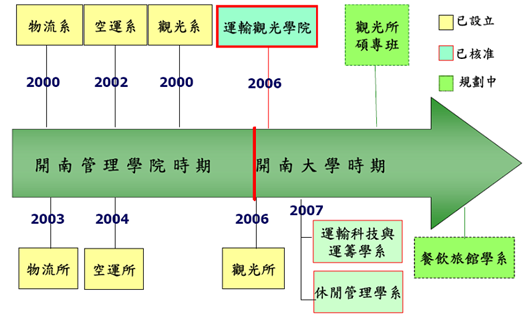
[Brief History]
The department was established in 1991, formerly known as the Department of Air Transport Management and Operations, and was renamed the Department of Air Transport Management in 1992, and added double classes and enrolled Bachelor of Advanced Studies. Class B; In the same year, the Air Transport Group of the Institute of Shipping Management and the Air Transport Group of the Institute of Enterprise Management were established and began to recruit students. In order to implement the concept of unity of departments and institutes in 1993, the Air Transport Research Institute was approved by the Ministry of Education to establish a master's program and an in-service master's program. Since 1999, the in-service master class has merged with the class system of the Department of Tourism and Logistics of the school and will be under the jurisdiction of the school. It is enrolled by the Air Transport Group of the School of Tourism and Transportation. The master's program was approved by the Ministry of Education in 2002 to stop enrolling students from the Republic of China (recommended to the School of Tourism and Transportation-International Transport Group), and was abolished in the Republic of China in 110. In addition, the Advanced Bachelor of Air Transport Management Department has been integrated with the school's Department of Tourism and Logistics since 1999. The college offers common compulsory courses for the freshman year, and the second year is based on interest and grades. At present, teachers are still provided by the department for in-service master classes, master classes, and undergraduate programs.
[Establishment Background]
The economic development of the world and other countries is extremely dependent on air transportation; while foreign passenger and freight must rely on air and sea transportation in Taiwan, air transportation plays a key role. It is the main axis of Taiwan's global development of the overall competitiveness operations research center. Therefore, the demand for air transportation around the world has been growing steadily, and countries are also actively working to expand their air transportation. This makes air transportation involving an extremely large system, which requires a large number of talents, and the world's demand for air transportation talents is very urgent. . Particularly important, the establishment of this department is based on: 1. To meet the needs of the national air transportation policy: To cope with the globalization and liberalization of domestic air transportation, and to cooperate with the government's policy of promoting Taiwan to become the Asian space transportation center, and to cultivate civil aviation administration and Air transportation management talents such as air transportation, warehousing, contracting, storage and distribution, and customs declaration. 2. To meet the needs of local development: The government actively develops Taoyuan International Airport and its surrounding areas into an aviation city in accordance with the air transportation center plan, and sets up an air free trade port area to make this area a major air cargo and passenger transshipment center in the country Because of the great demand for air transportation management manpower, the establishment of this department will help further assist local needs and development. Since the development of the knowledge economy is related to the breadth and depth of the country’s economic development, in order to cultivate air transportation talents and to cultivate the research and development of air transportation, Kainan University was adjacent to the Zhongzheng Airport. The university department was established in 1991.
[Targeting]
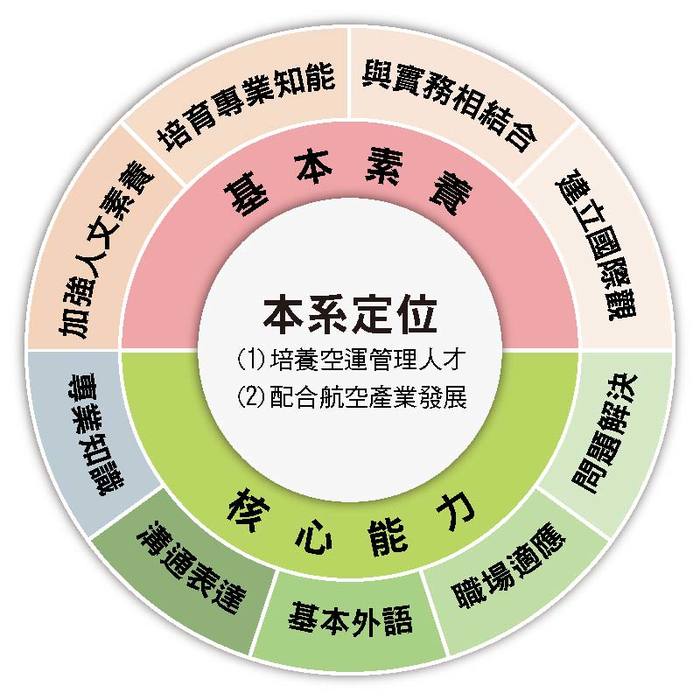
The positioning of this department is to pay equal attention to professional teaching and practical research, and to cultivate operational service and business talents in air transportation-related industries.
[Educational Goals]
Day Department
Strengthen humanistic literacy: Strengthen students' basic general knowledge ability, and cultivate a healthy personality of students who are dedicated and happy.
Cultivate professional knowledge: teach the management technology and professional skills of air transport core industry and aviation-related industries, and train students who are interested in continuing to study air transport/transportation science and related fields.
Combine with practice: Strengthen industry-university cooperation, provide industry exchanges and internship opportunities, and cultivate professionals in air transport related industries.
Establish an international outlook: strengthen students' foreign language ability, provide opportunities for international communication, and educate students to have a global vision.
Learning Department
Strengthen humanistic literacy: Strengthen students' basic general knowledge ability, and cultivate a healthy personality of students who are dedicated and happy.
Cultivate professional knowledge: teach the management technology and professional skills of air transport core industry and aviation-related industries, and train students who are interested in continuing to study air transport/transportation science and related fields.
Combine with practice: Strengthen industry-university cooperation, provide opportunities for industry exchanges, and enhance students' theoretical knowledge and practical application opportunities.
Enhancing international outlook: Strengthen students’ foreign language skills and expand their international horizons.
[Core Competence]
Professional knowledge and ability
Communication and expression skills
Basic foreign language skills
Workplace adaptability
Problem solving ability